The Highest Paid Execs in Real Estate

Between 2021 and 2023, the CEOs of real estate’s largest public companies had highly varied upside from the sale of company stock – ranging from $145 million to $0 – while their companies had massive financial gains and losses.
Why it matters: Executive compensation through stock sales is a worthwhile datapoint to consider when thinking about a CEO’s optimism about the future of their business – and how they are incentivized to lead that business.
-
And in reality, that compensation appears to be very loosely based on a company’s actual financial performance, if at all.
Dig deeper : Between 2021 and 2023 Opendoor experienced significant financial losses, with a combined net loss of $2.3 billion and an Adjusted EBITDA loss of $737 million — typically the most favorable financial metric (closely approximating cash flow).
-
During that time, Opendoor’s CEO sold $145 million in company stock through dozens of transactions – $112M during the first two years (as CEO) and $32M in 2023 (as president of marketplace) before leaving the company in January 2024.
-
Between the first sale in 2021 and the last sale in 2023, Opendoor’s stock declined 83 percent.

During the same three years , Zillow had a combined net loss of $787 million but a positive Adjusted EBITDA of $1.1 billion — significant cash flow.
-
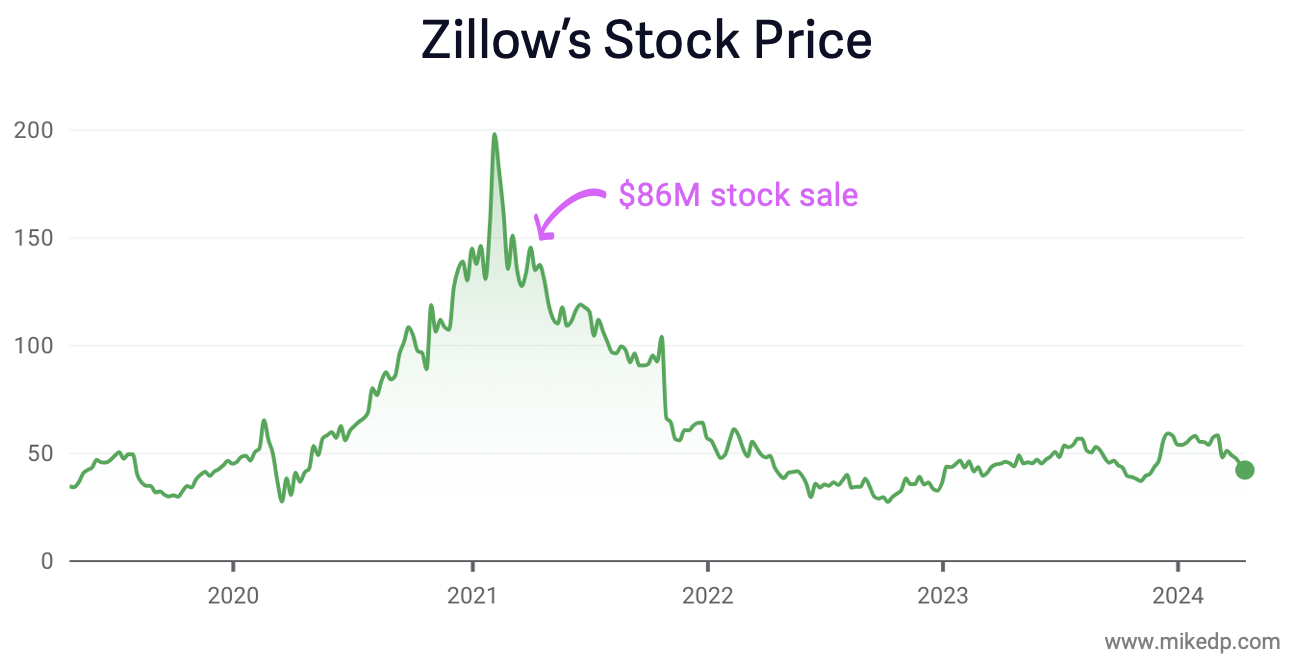
The CEO of Zillow sold $86 million of company stock in March 2021, when Zillow’s stock price was near an all-time high.
-
Zillow’s stock has dropped about 58 percent since then, but there have been no subsequent stock sales.
The other publicly listed companies round out the list, revealing several interesting outliers – including CEOs that have sold no stock.
-
The CEO of Redfin, which was unprofitable, sold $19 million in company stock — and also purchased $300k of stock in late 2023, while the CEO of eXp Realty, which was profitable, sold $71 million in company stock.
-
Interestingly, the CEOs of Compass (unprofitable) and Anywhere (profitable) have not sold any company stock during this same period of time.

It’s hard to ignore the outliers.
-
The former CEO of Opendoor, the most unprofitable company in the peer group, made the most from stock sales.
-
While the CEO of Compass, which went public about the same time as Opendoor, and the CEO of Anywhere, which was the most profitable, sold no stock.
The bottom line : There’s a before and after not included in this analysis: under what conditions a CEO was granted stock, why they decided to sell, and what they did with the money.
-
The focus here is the specific financial upside realized by the CEO – compensation for doing a job – how it compares to a peer set of CEOs, and how it relates to actual company performance.
-
The results are inconsistent and reveal a massive variance – more than I expected – and in that white space is an opportunity to learn more about incentives and intentions.